
Restoration SEO is not about collecting keywords for a monthly ranking report.
It is about appearing when a homeowner or property decision-maker has a real problem inside a territory you can profitably serve.
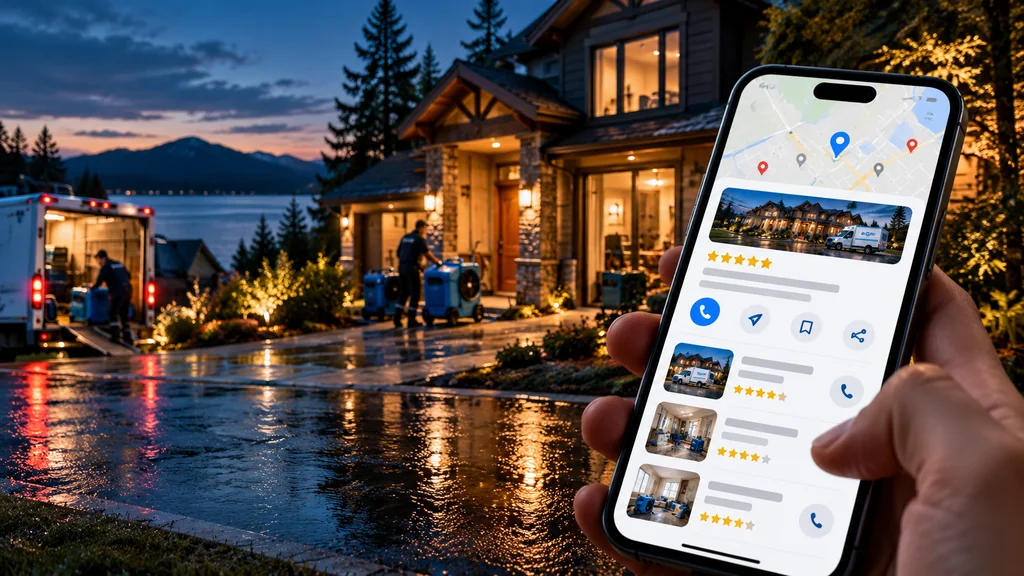
For water, fire, mold, sewage, storm, and emergency mitigation companies, local search is where intent, geography, reputation, and response collide.
Start with how Google says local ranking works
Google publicly describes local results as being primarily based on three factors:
Relevance - how well the business matches what the person is looking for.
Distance - how far the business is from the searcher or the location associated with the search.
Prominence - how well known or established the business appears to be.
You cannot manipulate distance.
You can improve relevance and prominence.
That is where the restoration SEO work lives.
1. Build the Google Business Profile correctly
Your profile should accurately communicate:
- primary service category
- legitimate secondary categories
- services
- hours
- phone
- website
- service area
- business description
- real photos
- reviews
- ongoing activity
Do not keyword-stuff the business name or invent locations. Short-term tricks can create long-term suspension risk.
2. Build service pages around real commercial intent
A restoration company should not have one generic “Services” page trying to rank for everything.
Build strong pages around the services you actually perform, such as:
- water damage restoration
- emergency water extraction
- structural drying
- sewage cleanup
- mold remediation
- fire and smoke damage restoration
- storm damage restoration
- contents restoration
- commercial restoration
Each page should answer the questions a stressed customer actually has:
What do you do? How fast can you respond? What happens next? Do you serve my area? Do you work with insurance? Why should I trust you?
3. Build geographic authority without creating thin city-page spam
Service-area SEO matters because restoration companies often cover a wide region.
The lazy tactic is publishing 80 nearly identical city pages with the city name swapped.
The stronger approach is to create pages that have a reason to exist.
Useful location pages can include:
- actual service coverage
- local response logistics
- local property risks
- storm/freeze/flood context
- relevant project examples
- local review proof
- nearby neighborhoods
- local FAQs
- real team or branch information
The goal is not to manufacture pages. It is to demonstrate local relevance.
4. Treat reviews as both trust and local-search infrastructure
Google explicitly notes that more reviews and positive ratings can help local ranking.
For restoration companies, reviews also improve conversion.
A review system should:
- request honest feedback consistently
- make the process easy
- avoid incentives
- avoid review gating
- monitor new reviews
- respond professionally
- use feedback to improve operations
Do not ask customers to insert scripted keywords into reviews. Let authentic service language emerge naturally from genuine experiences.
5. Make business information consistent
Name, address, phone, website, hours, and location data should remain consistent across the web.
Conflicting data makes it harder for platforms, directories, and AI systems to understand the business entity.
Audit important directories, data sources, social profiles, associations, and location pages.
6. Publish content that supports the buying journey
A restoration blog should not be a graveyard of generic homeowner tips.
Create content around two audiences:
Homeowner / property decision-maker content
Questions about water losses, mold, fire, insurance process, drying, cleanup, response, and prevention.
Restoration-owner / industry content
If your business sells to restoration companies - as Restoration Rocket does - publish around restoration marketing, SEO, lead generation, reviews, Google Ads, AI visibility, and market intelligence.
The correct topic universe depends on who you actually want to attract.
7. Expand beyond classic SEO into AI discovery
Modern discovery is fragmented.
A potential customer may ask Google, Maps, ChatGPT, Gemini, Perplexity, another AI assistant, a neighborhood group, or a review platform.
That makes entity clarity and third-party authority more important.
Strong SEO work increasingly overlaps with:
- structured business information
- useful expert content
- citations and mentions
- reviews
- consistent entity data
- clear service/location coverage
- trustworthy third-party references
Do not optimize for “AI” by creating hundreds of robotic pages. Build a web footprint that gives systems accurate reasons to understand and trust the company.
8. Measure the outcomes that matter
SEO should connect to:
- calls
- forms
- qualified opportunities
- service type
- source
- location
- booked jobs
- closed revenue where possible
Rankings are diagnostic data.
Jobs are business outcomes.
You need both, but do not confuse them.
Common restoration SEO mistakes
Mistake 1: Chasing rankings outside the serviceable market. Visibility in a city you cannot respond to has little value.
Mistake 2: Thin duplicate city pages. Scale without substance creates weak content.
Mistake 3: Ignoring reviews. A high ranking with weak proof can still lose the call.
Mistake 4: Treating the website and GBP separately. They should reinforce the same services, locations, trust, and entity information.
Mistake 5: Reporting only traffic. Track the path from search to opportunity to job.
FAQ
How long does restoration SEO take?
It depends on market competition, starting authority, technical condition, profile strength, content quality, and the work required. Local and organic improvements usually compound rather than behave like an on/off ad campaign.
Is Google Maps more important than the website?
They play different roles. The profile can win visibility and the initial click or call; the website provides depth, conversion, service/location coverage, and authority. Strong programs develop both.
Should restoration companies create a page for every city?
Only when each page can provide genuine local value. Do not mass-produce thin, near-duplicate city pages solely to target keywords.
See the search gaps in your actual territory
Generic SEO advice cannot tell you which competitors dominate your market, where your map coverage is weak, or which services have the clearest opportunity.
That is what the Restoration Market Gap Report is for.
Source note: Google's public Business Profile guidance describes local ranking primarily in terms of relevance, distance, and prominence.
Written by Isaac Voss