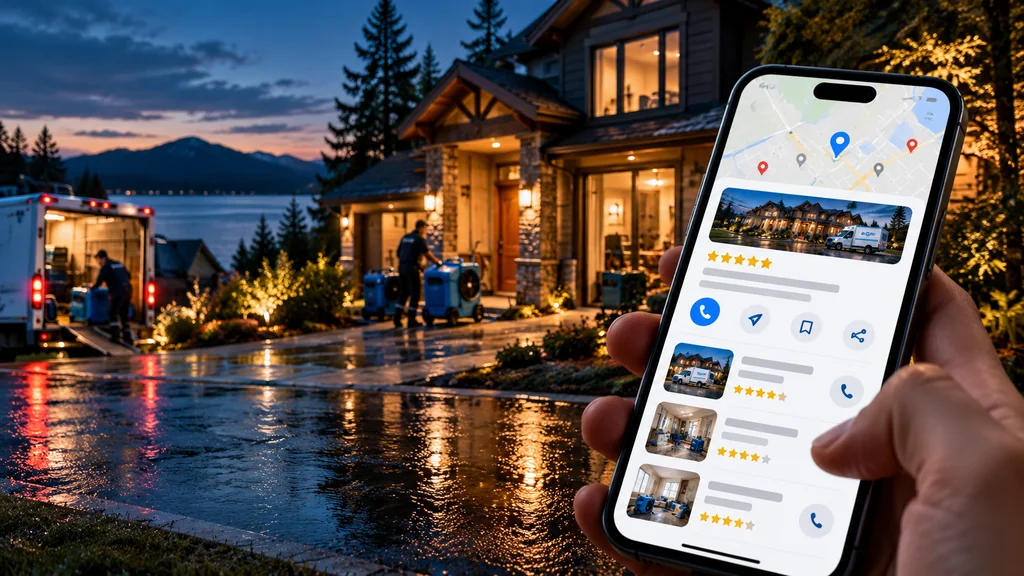

A homeowner no longer has to search “water damage restoration near me” and manually inspect ten websites.
They can ask an AI system a complete question:
“Who is a reputable water damage restoration company near me that answers 24/7 and has strong reviews?”
That changes local discovery.
Restoration companies still need Google Maps and organic search visibility. But they also need to understand a second question:
When AI systems assemble an answer, does your company appear - and what sources are influencing that answer?
AI visibility is not a single ranking
Classic SEO encourages owners to think in positions:
#1, #2, #3.
AI recommendations do not always work that way.
Different systems can produce different answers based on:
- the exact question
- location context
- available sources
- freshness
- review and reputation signals
- business/entity clarity
- service relevance
- authoritative third-party references
That means AI visibility should be measured across a set of high-intent prompts, not one vanity question.
What should a restoration company track?
Build a prompt set around the actual decisions customers make.
Examples:
- best water damage restoration company in [market]
- emergency water removal near [market]
- highly rated mold remediation company in [market]
- restoration company for sewage cleanup in [market]
- who handles fire and smoke damage in [market]
- 24/7 restoration company in [market]
Then track:
- whether your company appears
- which competitors appear
- relative position / prominence where measurable
- which sources are cited
- which sources repeatedly support competitors
- what information appears to be missing about your company
The most important AI visibility question: “Why them, not us?”
If a competitor is recommended and you are absent, the useful question is not:
“How do we trick ChatGPT?”
It is:
“What evidence exists on the web that makes the competitor easier to understand, verify, and recommend?”
That may include:
- clearer service pages
- stronger location pages
- better structured business data
- more authentic reviews
- more third-party mentions
- stronger association/directory presence
- more useful expert content
- clearer credentials
- more consistent entity information
AI visibility often exposes weaknesses that also affect ordinary search and conversion.
Build a stronger restoration entity
Your company should be easy for machines and humans to understand.
Keep the basics consistent:
- official business name
- phone
- locations
- service areas
- website
- services
- hours
- leadership / team where appropriate
- credentials
- review profiles
- associations
- social identities
Conflicting information weakens clarity.
Publish content that answers real restoration questions
Do not publish generic AI-written filler simply to create page count.
Strong restoration content should demonstrate useful expertise around:
- water losses
- drying and mitigation
- mold
- sewage
- fire and smoke
- storm response
- insurance process questions
- commercial restoration
- homeowner preparation
- local risks
For a B2B restoration-growth company such as Restoration Rocket, the content should instead answer the questions restoration owners ask about:
- lead generation
- SEO
- Google Maps
- reviews
- paid media
- AI visibility
- customer acquisition
- market intelligence
Content strategy should match the audience you want to attract.
Strengthen third-party corroboration
Your website saying “we are the best” is weak evidence.
Independent sources can create stronger corroboration:
- real customer reviews
- industry associations
- local news / PR when legitimate
- business directories
- partner mentions
- case studies
- community references
- high-quality citations
The goal is not to spray links everywhere.
It is to create a real digital footprint that consistently describes the company.
Reviews matter in the AI era for another reason
Reviews contain natural language about real experiences.
They can help customers - and systems analyzing public information - understand what a company is known for.
The correct approach is still simple:
Ask real customers for honest reviews. Do not buy, gate, or script them.
AI visibility should connect to action
A dashboard showing that you appear in 42% of prompts is only useful if it helps answer:
- Which prompts matter most?
- Which competitors are winning them?
- Which sources are helping those competitors?
- What is missing from our footprint?
- What should we build next?
That is the difference between measurement and market intelligence.
Do not abandon Google to chase AI
This is not “SEO is dead.”
The better model is:
Google + Maps + AI recommendations + reviews + third-party authority + paid media + conversion.
Discovery is becoming more fragmented, not less.
The companies with the clearest, strongest, most trustworthy footprint will be easier to surface across multiple environments.
FAQ
Can I pay to rank in ChatGPT or other AI recommendations?
Organic AI recommendations are not the same thing as buying a search ranking. Paid products may exist in some environments, but do not treat organic recommendation systems as a simple ad slot.
Is AI visibility the same as SEO?
They overlap, but they are not identical. Traditional SEO focuses heavily on search-engine visibility. AI visibility also requires monitoring answers, citations, entity understanding, and recommendation behavior across multiple systems.
How do I know which sources AI trusts in my market?
Run a structured set of local, high-intent prompts across multiple AI/search environments and analyze the sources repeatedly cited for you and your competitors.
See who AI is recommending in your market
A Restoration Market Gap Report can compare your search and AI footprint against the companies already winning local attention.
Written by Isaac Voss