
Restoration companies are unusually expensive businesses to market badly.
A generic home-service strategy can generate traffic and still miss the realities that matter:
- emergency demand
- service radius
- high job-value variance
- after-hours response
- insurance involvement
- Google Maps competition
- review trust
- storm/freeze demand spikes
- technician and crew capacity
- attribution from call to closed job
Before hiring a restoration marketing agency, ask questions that reveal how the company actually thinks and operates.
1. How many restoration companies have you actually worked with?
Ask for specifics.
Water damage, fire, mold, sewage, storm, commercial, franchise, independent - experience should show up in the examples and the vocabulary.
Do not accept “we work with home services” as a complete answer.
2. What do you believe creates a qualified restoration opportunity?
A serious answer should go beyond “a form fill.”
Listen for:
- service type
- geography
- urgency
- customer fit
- booked inspection / dispatch
- closed job
- source
3. How do you measure success?
Traffic and rankings matter diagnostically.
The agency should also be able to discuss:
- qualified calls
- booked opportunities
- cost per opportunity
- closed jobs
- revenue attribution where available
- job economics
4. How do you handle Google Business Profile and local search?
Restoration is intensely local.
Ask how the agency approaches:
- categories
- service areas
- reviews
- photos
- local landing pages
- citations
- location authority
- competitor map coverage
5. What is your review-generation policy?
The answer should not include buying reviews, incentives, review gating, or scripts that pressure customers to write specific keywords.
You want a legitimate, repeatable feedback system.
6. What is your Google Ads measurement model?
Ask whether they track only leads or whether they can connect campaign performance to qualified calls and closed outcomes.
If they cannot tell good calls from bad calls, optimization will eventually hit a ceiling.
7. Do you understand AI search and recommendation visibility?
The agency does not need to use buzzwords.
But it should understand that customers now discover companies through more than classic Google results.
Ask how it evaluates:
- AI recommendations
- citation sources
- entity clarity
- third-party authority
- reviews
- search + AI overlap
8. Do you have a strategy beyond search?
Search is important, but the market also lives on:
- social
- streaming TV
- online video
- websites
- retargeting
- community platforms
- referrals
Ask whether the agency knows when those channels make sense - and when they do not.
9. How do you decide which market to attack?
A good answer should include more than population.
Look for analysis of:
- demand
- competitors
- service capacity
- travel / response logistics
- job values
- location strength
- current visibility
- review gaps
- media costs
10. Will you work with my direct competitor?
This is a major question in restoration.
Some agencies work with multiple companies in the same market.
Others provide category/territory protection under defined agreements.
Neither model is automatically wrong, but the policy should be transparent.
11. Who owns the accounts and data?
Clarify ownership of:
- ad accounts
- website
- domain
- analytics
- call tracking numbers
- CRM data
- creative
- audiences where transferable
- content
Do not discover the answer after the relationship ends.
12. What happens in the first 90 days?
A credible agency should have an implementation sequence.
That may include:
- market analysis
- tracking
- profile/site fixes
- creative
- paid media launch
- review system
- authority/content work
- conversion improvements
- baseline reporting
Beware of plans that are nothing more than “we will start SEO.”
13. What do you need from us?
Marketing is not completely passive.
The agency may need:
- access
- approvals
- service-area information
- photos/videos
- call outcomes
- CRM data
- job values
- reviews/testimonials
- operational feedback
A provider that says you never need to participate may be hiding how shallow the program is.
14. What claims are you willing to guarantee?
Be cautious with guaranteed rankings, guaranteed lead counts, or guaranteed ROI unless the exact terms are written and measurable.
A serious provider should be willing to distinguish:
- targets
- historical examples
- forecasts
- contractual guarantees
Those are not the same thing.
15. Can you show me my market before recommending the package?
This may be the most important question.
A restoration marketing recommendation should reflect the actual territory, competitors, demand, capacity, and gaps.
If every company gets the same package before anyone looks at the market, you are buying a product catalog, not a strategy.
The red flags
Walk carefully when you hear:
- “We guarantee #1 on Google.”
- “You do not need call tracking.”
- “Reviews are easy; we have a shortcut.”
- “We work with everyone in your city and it does not matter.”
- “Traffic is up, so the campaign is working.”
- “AI visibility is just adding ChatGPT keywords to blog posts.”
- “We cannot show you which opportunities became jobs.”
Specialist vs generalist
A strong generalist can sometimes do excellent work.
A restoration specialist should have an advantage in the operating context.
But niche branding alone does not guarantee competence.
Choose the team that can prove it understands:
market -> demand -> discovery -> trust -> response -> job economics.
FAQ
How much should a restoration marketing agency cost?
It depends on scope, market, media, services, and how much execution is included. Compare the fee against your job economics and the work actually being delivered, not a generic industry average.
Should I hire one agency or multiple specialists?
Either can work. The risk with multiple vendors is fragmentation. The risk with one provider is weak capability in one layer. The key is clear ownership, data sharing, and one view of business outcomes.
Should my marketing agency have market exclusivity?
It depends on the model. If exclusivity matters, define the category and territory in writing rather than relying on verbal assurances.
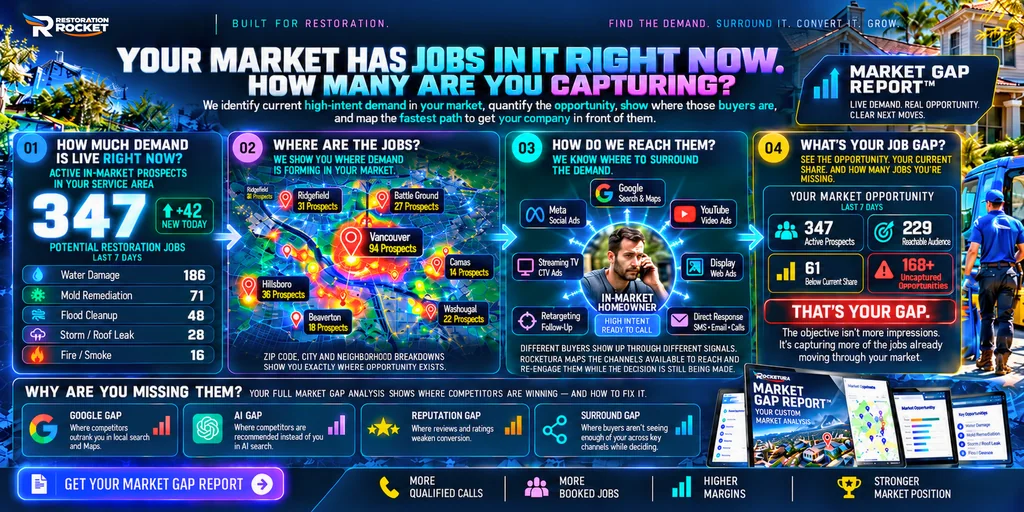
Before you sign another proposal, see the market
Restoration Rocket's starting point is the Restoration Market Gap Report - not because a report is the end product, but because the market should determine the plan.
Written by Isaac Voss